Key Takeaways
· Emerging technologies, such as Electromechanical Reshaping (EMR) and Implantable Collamer Lenses (ICLs), present effective alternatives to LASIK.
· These procedures focus on safety, reversibility, and suitability for patients with complex eye conditions.
· Continued research is crucial for refining and validating these new methods.
Breakthroughs in vision correction are quickly reshaping the eye care landscape. While LASIK has been the centerpiece of surgical refractive correction for years, new solutions are emerging that are less invasive, more versatile, and tailored to a broader range of patients. Innovative technologies, such as the EVO ICL lens and non-invasive corneal reshaping, are pushing boundaries and opening new doors for those seeking a life without glasses or contacts.
As vision science progresses, individuals who weren’t suitable candidates for LASIK or who are hesitant about permanent corneal alteration now have more options than ever before. This shift is not only about making procedures safer and more effective, but also about expanding access to vision correction that adapts to evolving patient needs and lifestyles.
Introduction to Vision Correction Alternatives
For decades, LASIK has dominated the conversation regarding freedom from glasses or contact lenses. However, an increasing awareness of its limitations including disqualification due to thin corneas, dry eye, or high refractive errors has motivated researchers and clinicians to develop alternatives. These newer procedures are quickly gaining traction in the ophthalmology community, offering solutions to address shortcomings that LASIK cannot meet.
Modern patients rightfully demand treatment options that suit their daily lives, eye health, and long-term vision goals. This patient-first focus is driving the evolution of both surgical and non-surgical approaches, making vision correction safer, more personalized, and more reversible when desired.
Electromechanical Reshaping (EMR): A Non-Invasive Approach
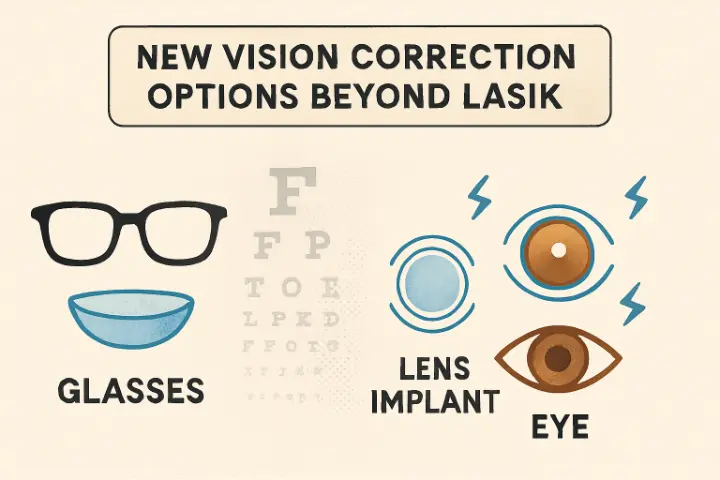
One of the most exciting frontiers is Electromechanical Reshaping (EMR) of the cornea. This procedure utilizes controlled electrical stimulation to reshape the corneal tissue, rather than relying on incisions or ablation. Unlike traditional LASIK, which removes corneal tissue to alter the eye’s focusing power, EMR gently prompts the collagen within the cornea to reorganize, correcting the shape and, thus, the patient’s vision. This minimally invasive method has demonstrated success in early clinical animal trials and is poised for further research in human studies, promising safer interventions with fewer complications or side effects. Researchers at major academic centers are monitoring developments in EMR for its potential to revolutionize the field.
Implantable Collamer Lenses (ICLs): Reversible and Effective
Unlike LASIK, which irreversibly changes the cornea, Implantable Collamer Lenses (ICLs) offer a reversible option. ICLs are soft, biocompatible lenses placed inside the eye, between the iris and the natural lens. They can address a wide range of refractive errors, including high myopia and severe astigmatism, making them viable for patients who may have previously been excluded from vision correction surgery. The great advantage of ICLs is that the eye’s natural anatomy is preserved and can be restored if necessary if vision needs further adjustment as the patient ages, the lens can be replaced. ICLs, such as the EVO ICL, are gaining momentum in eye care practices worldwide and are considered particularly suitable for individuals with thin corneas or dry eyes. For broader background and ongoing studies related to ICLs, see Healthline's overview of ICL surgery.
Advancements in Laser Technology
Despite the surge of newer procedures, advancements in laser-based vision correction are keeping LASIK a strong contender. Modern femtosecond lasers and excimer technologies have significantly improved precision and safety. Enhanced mapping of corneal irregularities, guided by computer algorithms, enables ultra-personalized treatments with better outcomes and faster recovery. Recent research and clinical reports emphasize that the best results often come from individualized treatment plans, made possible by these next-generation devices. Safety records are at an all-time high, as highlighted by the American Academy of Ophthalmology, making LASIK continuously relevant for a large population of patients.
Pharmacological Solutions: Eye Drops for Presbyopia
For adults struggling with presbyopia the age-related loss of close-up vision pharmacological advancements are arriving rapidly. Prescription eye drops, such as pilocarpine, temporarily increase the depth of focus by constricting the pupil, allowing users to see near objects more clearly without the need for reading glasses. Though not a permanent fix, these medicated drops offer a significant lifestyle improvement for many, and the technology is developing rapidly. Clinical studies continue to examine the long-term safety and practicality of pharmacological agents as a supplement or alternative to surgical solutions, expanding options for middle-aged and older adults seeking non-invasive correction.
Considerations for Choosing the Right Procedure
The selection of a vision correction procedure is a highly individualized decision. Factors such as corneal thickness, type and magnitude of refractive error, age, eye dryness, and personal lifestyle needs must all be carefully evaluated by a qualified ophthalmologist. Modern eye care is more collaborative and informed than ever: patients are encouraged to ask questions, discuss their goals, and thoroughly assess the risks and benefits of each available technology before making a final choice. A personalized approach remains at the core of successful vision correction outcomes.
Conclusion
As technology continues to advance, the future of permanent vision correction is expanding far beyond LASIK alone. From reversible lens implants like ICLs to non-invasive corneal reshaping and pharmacological breakthroughs, patients have more choices than ever. Ongoing research will further validate and refine these solutions, making clear, unaided vision possible for nearly everyone safely, effectively, and tailored to individual lives and needs.
The Future of Permanent Vision Correction: Options Beyond LASIK